Friday, September 19, 2014

MARIJUANA "LeGaL 0R N0T" ?


                                    Our Confused Legal Situation

1) Preamble


Marijuna ("weed"or "pot") is a general term for the leaves and/or buds of the cannabis sativa ("marijuana") hemp plant. It is usually used and inhaled like a cigarette ("joint") or in small pipe. It is sometimes smoked in an emptied cigar to make a "blunt"with a cigar flavor. The major active ingredient in marijuana (cannabis) is tetrahydrocannabinol or THC.

Hashish (or hash oil) is solid or resinous depending on the processing of the resin of the cannabis flowers and is more potent than marijuana. It is consumed by being heated in a pipe,  hookah, bong,  bubbler,  vaporizer, or hot knife. It may be mixed with cannabis buds or tobacco and smoked in joints, or smoked as bottle tokes ("brewing bots", "bucket bongs"). It is the active ingredient in "pot" cookies or brownies or cooked in various  foods.

1) Pre-Marijuana Drug prohibition in Canada:
     - began with the Opium Act of 1908
     - followed by the Opium Drug Act of 1911, which outlawed the sale or possession of opium (and by
        implication heroin) and cocaine.
  
2) Cannabis was added 1923
       The Confidential Restricted List in 1923 under the Narcotics Drug Act Amendment Bill added other unidentified drugs and was understood to include cannabis (although not identified by name). This has since been taken as including marijuana as a narcotic.
     Since then Marijuana has been "officially" classified as a narcotic and treated as such for legal matters (e.g. border crossing) in spite of it having little in common with actual narcotics.
 
   The following discussion was taken from a recent Canadian reality TV show "Border Security":

           Border Officer: "Have you used any kind of narcotic in the last 6 months?"
           Traveller:          "No sir."
                                      . . .  after several unrelated questions . . .
           Border Officer: "Have you used marijuana in the last 6 months?"
           Traveller:           "A couple of times."
           Border Officer: "We have a problem. You lied to me when you said you hadn't used a narcotic."
    
    Lying to a Border Official is adequate reason to launch an intensive search, and arguing is not a good option because in his book, Marijuana is listed as a narcotic.

3) Marijuana as a sociological phenomenon 

       It has been discussed in many books and college texts such as "Panic and Indifference"

Internet websites list the most
 "marijuana friendly" campuses
 
 - Cannabis was added of the Opium and   Narcotic Drug Act in 1923, before cannabis was identified as a social issue in Canada -- - a "solution without a problem" (p. 179).
- The first seizure of marijuana cigarettes occurred in 1932, nine years after the law passed (p. 182)
- First four possession offenses were in 1937,
14 years after the criminalization (p 599)


There are several accredited US "marijuana universities" which offer degree courses and degrees in drugs including marijuana such as:
    -Oaksterdam University in Oakland, California offers a full slate of Cannabis related courses
    - Clover Leaf University (Colorado) has state approval for 16 stand-alone course and 4 full medical marijuana certifications.
 
Report of Senate Committee (2001/2002):
           Number of reported marijuana offenses in Canada (1999) were 35,000
           Number of reported marijuana offenses in Canada (2001) were 71,600
           Estimated  number of  marijuana  users  in Canada (2002) was 2.3 million

 Sabeena Ahmed wrote an excellent Canadian essay "THE LEGALIZATION OF MARIJUANA" (Sept 2003) for her third-year University of Toronto University sociology course. Her conclusion is:
    "it is in the researcher's opinion that the present Canadian law tends to "over-criminalize" marijuana and alternative policies dealing with the legislation of marijuana need to be considered that deal with the "marijuana problem" more realistically."

  4) The Move To "Legalize" Marijuana For Medicinal Use

 - A Canada-wide Health Promotion Directorate was established to include an anti-drug campaign promoting that "kids shouldn't try marijuana or hashish until they are at least 18, and mature enough to decide responsibly" and should "stay real". This mild approach impressed even pro-marijuana groups like the National Organization for the Reform of Marijuana Laws (NORML).
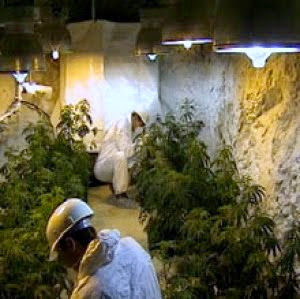
- 2002 the Government of Canada gave a four-year contract to a Saskatoon-based company for the production of medicinal marijuana. Prairie Plant Systems, used an inactive underground copper/zinc drift owned by the Hudson Bay Mining and Smelting to produce approximately 400 kilograms of medicinal marijuana annually. Because marijuana plants and seeds were illegal the company used whatever seeds the RCMP had confiscated in drug busts with no concern for quality or strain of marijuana. The result was an expensive and poor quality product which was inadequate for medicinal use. When the operation closed in 2009 more than 1,400 Canadians were authorized to possess marijuana for medical purposes. Of those, about 300 people received the Prairie Plant Systems product. The others used "illegal" privately grown Marijuana.

- 2013 there were 28,000 people in Canada who held a personal-use or designated operation production license under the MMAR (Marijuana Medical Access Program Regulations. This program ended Mar 31, 2014.

- March 2014 commercial producers began being licensed across the country under the MMPR (Marajuana for Medical Purposes Regulations) with amendments (2014).
Amendment  As of Sept. 2014 thirteen sites have been licensed. They are big business operations.  For example, Bonify Medical Cannabis in Winnipeg invested a million dollars and has 2 growers in hopes of receiving a license.

It is interesting to note that although this program is under the auspices of  Health Canada who will monitor the program, and is in charge of hiring and inspecting it - in spite of the 2014  Federal Government official position:
     "Dried marijuana is not an approved drug or medicine in Canada. The Government of Canada does not endorse the use of marijuana, but the courts have required reasonable access to a legal source of marijuana when authorized by a physician".

At the same time, Health Canada is not able to control legal (but possibly harmful) drugs. What hope is there that they will be able to deal with the situation surrounding Cannabis?

(6) CANNABIS LEGALITY IN CANADA (and USA)
      (a) Federal
           Federal regulations as of 2014-09-01 are found listed under "Narcotic Control Regulations"
          2014  Federal Government website official position is: "Dried marijuana is not an approved drug
          or medicine in Canada".
      (b) Provincial
           Provincial laws and regulations in some cases seem to defy the Federal position.
           In some jurisdictions police are not enforcing the laws, leading to an understanding that it is legal..
          New regulations for medical marijuana come into effect in Canada on April 1, 2014,
          but licensed home growers are allowed to continue to produce their own pot pending a future trial.


(c) USA
     - States with legalized cannabis: Washington, Colorado

    - States with legal medical cannabis - Washington, Oregon, Nevada, California, Montana, Arizona, New Mexico, Colorado, Minnesota, Illinois, Michigan, Hawaii, Alaska, New Hampshire, Vermont, Massachusetts, New York, Maine, Rhode Island, Connecticut, New Jersey, Delaware, Maryland Washington D.C.

     - States with decriminalized* cannabis possession laws: Oregon, Nevada, California, Colorado, Arizona, New Mexico, Nebraska, Minnesota, Mississippi, Ohio, Virginia, Alaska, New York, North Carolina, Rhode Island, New Jersey

* "decriminalized " means the offense is like a parking ticket - a fine but no legal action or record.

***

     Cannabis In Main Stream Canadian /USA Society  
        For The Do-It-Yourself Enthusiast


*********

Monday, September 8, 2014

EVERYTHING (and more) YOU WANT IN A WATCH


Samsung Gear S


   Although running a newer version of the Tizen software, using the Gear S is different from using any of the older Samsung watches.

 
Samsung Gear S (Photo: Will Shanklin/Gizmag.com) 

 It has a "spacious" 2-in curved screen that features its virtual keyboard. It must be a bit strange tapping out texts or emails on a curved 2-in screen, but Samsung auto-correct is reported to be quite effective.    


Despite its 3G radio, the Gear S isn't designed to replace your phone. But it can work partially without one.


******************************* 


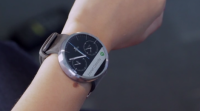
     "We're doing something (with the Moto 360) that looks like a watch and acts like a watch but does much more," said Motorola's design head Jim Wicks.  during an introductory session to the Moto 360. The Moto 360, when paired with the new Moto X and the Moto Hint.


     The Moto 360 also works as an activity tracker and pedometer with a heart rate monitor. An included heart activity app helps you work towards health and fitness goals.
As with other Wear watches, simply saying "Ok, Google" calls the Moto 360 to attention to answer queries.


     The Moto 360's display is 1.56 inches across with resolution of 320 x 290 (205 pixels per inch). A 320 mAh battery should get you a full day of use.
     It has a TI OMAP 3 processor with 4 GB of internal storage and 512 MB of RAM. Dual microphones give better voice recognition. It has a water resistance rating of IP67.


*******

Sunday, August 3, 2014

Autonomous (driverless) Cars and Robots

(SOON WE WON'T NEED PEOPLE EXCEPT FOR MAINTENANCE)

 1) Robot Dude Hitches Across Canada


     Armed with little more than a primitive ability to beg for rides, a Canadian robot aiming to hitchhike from Halifax to Victoria has already made it to the Quebec border in its first 24 hours.
      Now, hitchBOT — a device constructed from a plastic bucket, solar panels and a tablet computer — only needs to cover the remaining 5,600 kilometres without being smashed, stolen or dismantled.
     The device is equipped with arms and legs made from pool noodles and a simple LED screen displaying a smiling face. It has no moving parts and is designed to cajole drivers into picking it up, using a rudimentary ability to understand human speech.
    When they ask the inevitable “where are you going?”  the robot’s electronic voice responds:
           “I’m headed to Victoria BC, as far west as I can manage. Going my way?”
     Drivers are also asked to plug the robot into their car’s cigarette lighter to charge its batteries.

Related links:


2) United Kingdom Authorizes Driver-less Car Tests For 2015

3) Google Cars Can Drive Themselves
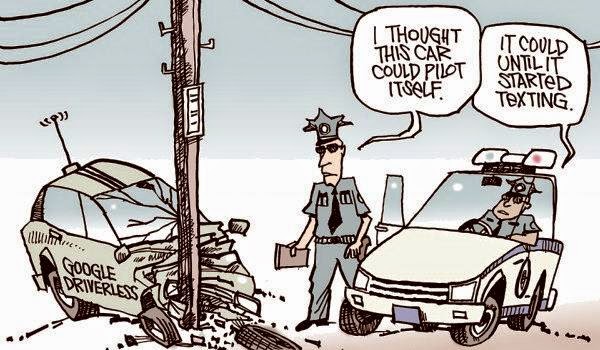
            The Nevada Department of Motor Vehicles approved Google’s license application to test autonomous vehicles on the state’s roads. The state had approved such laws back in February, and has now begun issuing licenses based on those regulations. Google’s self-driving car is still at least five years away from commercialization, but the team behind the project has made remarkable progress since starting work in 2009 (taken from WIRED magazine).
        Having traveled some 700,000 autonomous miles, the Google cars have learned a lot, such as:
HOW TO:
   Avoid creaming cyclists: In the event a cyclist actually decides to warn traffic before he turns, the car notices. Thanks to laser imaging, the car recognizes the hand waving and will expect the cyclist to move over.
      Be aggressive: It turns out self-driving cars tend to be too polite. Google noticed that at four-way stops, the car stayed behind the stop line, waiting for its turn. Naturally, human drivers, seeing it just sitting there, took advantage and crossed ahead of it. So the team rejiggered the car to slowly inch forward at stop signs, signaling to other drivers that it wants its turn.
     Break the law: For city driving, Google keeps it legal. But on the highway, team members adjust the settings to let the car drive above the speed limit, to safely keep up with the flow of traffic.
     Pick up on potholes:Like with speed bumps, the car spots potholes and slows down before hitting them. It doesn’t drive around them, though, so owners should think about saving up for a new suspension once in a while.
     Predict the future that didn’t happen: Say the driver takes control because he isn’t confident the car will properly handle a tricky situation, like navigating construction. The car shoots all of the info its sensors are picking up, so the team can run a computer simulation of how the car would have acted if the operator had let it handle things. That means Google doesn’t have to find out the hard way it needs to tweak the car’s behavior.

BUT THEY STILL CAN'T:
    Take you to the mountains: Bad weather doesn’t just make traction control tricky, it change how the car sees the world around. Snow on the ground and water kicked up by other cars messes with the spinning laser that sits on the roof, while fog limits how far the radar can see. Fortunately, Google is doing the bulk of its testing the Bay Area, where it will get a lot of practice with fog. Ten bucks says engineers are lobbying for a trip to Tahoe–you know, for snow testing. 
    Go off the grid: Like a millennial, the car gets upset when it can’t get a cell signal, which gives it access to Google’s bank of detailed maps and let it send new information back home. No worries if the connection is a bit slow, but if it drops out, the car will “do something safe. 
    Understand traffic cops: The car will detect that “there’s a person standing in the middle of the road waving their hands in a funny way,” Software Lead Dmitri Dolgov said, but it won’t be able to decipher different hand motions. Rather, it will understand that something unusual is happening, and act conservatively, or ask the human at the wheel to take over. 
    Avoid creaming squirrels: While the car picks up pedestrians who may jaywalk and deer that could bolt across the road, squirrels are still too small for its sensors. The team is constantly working to pick up more and more detail, but hasn’t “done a squirrel test,” Urmson said.
4) Legal Problems and Ethics with Autonomous Cars
    (a) Nevada is accepting applications for licensing driverless cars for 2015
    (b) Who will be liable when an autonomous car crashes with a driver-driven car? Or if two driverless cars collide? The New Yorker (and other Internet sources) have interesting comments and debates.
 

5) What About Speeding Tickets?
   (a) Fines for speeding are always a problem. Different countries have tried different approaches. For instance, setting the fine in accordance with the person's income has led to to HUGE fines in some countries.
   (b) Although one would expect a robot car would never speed, Google's cars are programmed to break the law in the interests of safety in some cases. And then again, there are "speed traps".
                My friend Derrick reported on Facebook the following discussion when stopped by the highway police .
               The policeman :"Didn't you see the speed sign? "
               Derrick: "Of course I saw the sign.  It was YOU I didn't see."
 Will driverless cars be programmed to detect police?
   (c) Who will be responsible for speeding tickets? With driver-driven cars the responsibility is usually with the driver as being in charge of the vehicle. With autonomous vehicles it would probably be the owner? Or the vehicle programer?


(6) The Big Philosophical (but useless) Question:
       Will autonomous cars be programmed to pick up hitchhikers? And if so, will they stop for a hitchBOT standing on the roadside to give him/her/it a ride?   

***************************

Friday, April 12, 2013

alternate energy sources


SOLAR ENERGY NEWS

1)    A Spectrolab solar cell recently set a world record by converting more energy from the sun into electricity than any other ground-based solar cell without solar concentration.
    The cell converted 37.8 percent of solar energy using a new class of high-efficiency multi-junction solar cell, created from two or more materials and leveraging Boeing technology that makes semiconductor materials more reliable. The record was set without concentration, the common practice of having lenses or mirrors focus solar rays on the cells. "We expect this solar cell technology will have significant benefits for space, ground-based, and sensor applications," said Troy Dawson, president of Spectrolab.
     Spectrolab believes this solar cell technology can attain higher levels of efficiency, "possibly more than 45 percent even under low concentrations," according to Nasser Karam, the company’s vice president for advanced technology.


HARNESSING WIND ENERGY

A.  Wind farms

   - In London, England, 175 Siemens wind turbines each with a capacity of 3.6 MW, the massive energy project has been under construction since March 2011.  A peak output it is expected to generate 630MW, finally putting Britain’s notoriously bad weather to good use. Located nearly 18 miles offshore on the outer Thames Estuary, the London Array’s 175 turbines are spread across 90 square miles.             
      Building an array of this size on the open seas was no small feat. Even setting aside its sheer scale, the Array had to be built in the notoriously rough winters of the English Channel, which while wonderful for powering a wind farm, but not so much for building one.
   This is the world’s largest operational offshore wind farm and is capable of generating enough energy to power nearly half a million homes and reduce harmful CO2 emissions by over 900,000 tonnes a year. It plans to expand the Array to produce 870MW.


B.  Other major wind farms:
      While the London Array may be the world’s largest wind farm today, several projects are under development to create offshore wind farms in the UK,
     Sweden and Japan that will eclipse the capacity of the London Array. Chief among these projects is the Bleking Offshore wind farm being considered by Sweden’s environmental court. If approved, the Swedish wind farm could one day generate 2.5GW from the winds of the Baltic Sea.


C. Non-spinning blade generators:    


Solar Aero uses boundary layers                                         Saphonian bladeless  turbine
          instead of blades                                                                 with a disc-like system


D. No moving parts
        Dutch researchers have developed the EWICON, a bladeless windmill with no moving parts, that produces electricity by pushing charged water droplets into the wind.


Wave Glider Ocean Robots

      Liquid Robotics is revolutionizing our understanding of the oceans with its unmanned sensor with advanced capabilities such as a hybrid propulsion system.
     The new model can use solar power for propulsion. The earlier models used wave energy for propulsion and solar power for sensors and communications. The new solar cells for the robot are 50 percent more efficient, allowing them to power the propulsion system.     Liquid Robotics gained a spot in history when it announced in December that Papa Mau, one of its data-collecting second-generation Wave Gliders, had floated more than 9,000 miles across the Pacific Ocean. 
     Wave Gliders can collect data on weather in remote locations. They can be used to monitor hurricanes, predict tsunamis, and monitor rare marine life. Wave Gliders collect data on temperature, winds, humidity, wind gusts, water temperature, water color, and water composition. They can also take pictures. These robots are gathering a lot of observational data about climate change, ocean acidification, fisheries management, hurricane and tsunami warnings, and exploration — but in a green way.


Does your golf game need help?


"FORE!! Three - Two - One - Fire!" called Doug Frost, inventor of Rocketry Golf and Manager of the Rocketry Golf Organization. Then he launched his ball (on the nosecone of a model rocket) from the tee of the par-five 433-yard first hole at the Ridge Golf Club in Auburn, California. Not fazed by the uphill approach shot to the green, he placed his tee shot

...err...launch... only 23 feet from the hole. Unfortunately, Doug isn't much of a regular golfer, and two-putted in for a birdie. Frost's rocketry golf replaces your golf clubs with a selection of rockets and a putter. The rockets are used to launch the ball onto the green, where the traditional putter comes back into play.
     Check this new way of "golfing"  GizMag,com.


Top 10 Speeds Clocked on the Autobahn*


#1)  268.8 miles per hour (432.59 kilometers per hour): Mercedes-Benz W125

#2) 268.432 miles per hour (432 kilometers per hour): V-16 Auto Union

#3) 236 miles per hour (381 kilometers per hour): Porsche 9ff GTurbo850

#4) 219 miles per hour (353 kilometers per hour): Bugatti Veyron

#5) 208.7 miles per hour (335.87 kilometers per hour): Ruf R Turbo (Porsche) . 

#6) 206.3 miles per hour (332 kilometers per hour): Kelleners BMW M6

#7) 201.3 miles per hour (323.96 kilometers per hour): Ruf CTR Yellowbird (C) (Porsche)

#8) 200.7 miles per hour (323 kilometers per hour): Porsche 911 GT3 RTS 4.0

#9) 199 miles per hour (320 kilometers per hour): Lamborghini Aventador

#10) 192 miles per hour (309 kilometers per hour): Corvette ZR1

*obtained from: www.howstuffworks.com

        This information was obtained (according to the website) from second hand sources and I list it here only for interest - not as factual information nor personal experience ( I wish ) or how the cars were equipped. 


*******************************************

Tuesday, April 2, 2013

NOTHING I WOULD WANT - LOL

           (BUT MAYBE INTERESTING?)

1)  Worried about Zombies on the highway? 

       Car website Auto Blog revealed Robert Kirkman's latest creation: a custom Hyundai Elantra Coupe modified for zombie slaying. Set to debut around The Walking Dead's 100th issue at San Diego Comic-Con, a real, physical car was turned into the "Zombie Survival Machine" by Design Craft, modeled after a sketch done by Kirkman. It also features a vinyl wrap of The Walking Dead #100 cover.


2)  Or maybe you worry about being attacked by supersonic tennis balls?

           New radar, developed for the British Royal Navy’s Type 23 Duke-class frigates, is designed to simultaneously detect 900 targets smaller than a bird, against background noise equivalent to 10,000 mobile phone signals at ranges from 200 meters (656 ft) to 200 kilometers (124 mi). 
     It could detect a tennis ball traveling at Mach 3 (1,980 mph, 3,186 km/h) from a distance of 25 kilometers (15.5 mi). 


3)  If you like the Swiss Army Knife  you might like this "wallet"


- screwdriver (flat or Phillips)
- nested wrench (in SAE or metric)
- two-inch ruler,
- bottle opener
- twist top opener
- wing nut wrench,
- smartphone tablet stand
- can top popper
- box opener
- keychain
- holds credit cards, etc


      This item is NOT available (no matter how much you fell you can't live without one) because the creator needed money to fund its production. And this is the interesting part for me. It is being funded by "crowdfunding"  using a program called Kickstarter.
      There are several similar programs that raise money by "donations" to fund innovative products like CD's, films, games, music, art, design, technology etc. If this piques your interest (as in, you have ideas but no money) use Google to search for "crowdfunding" sites.
      Also see "Stompy" at the end of this posting for a $97,817 pledged for a project. 


4)  Realistic April Fool's jokes:

     a) Early on Monday, (as a joke), Google promoted a new service called Google Nose that would enable users to scan a 15 million "SCENT-BYTE" database of smells from around the world. 
       Their idea was scooped by the "smelling screen", invented by Haruka Matsukura at Tokyo University of Agriculture and Technology in Japan, Smells appear to come from the exact spot on any LCD screen that is displaying the image of a cup of coffee, for example. It was demonstrated at the IEEE Virtual Reality Research Demonstration in Florida, March 16-23rd.     

     (b) Twitter announced a new plan (called "twttr") to increase user efficiency by eliminating the use of vowels in their 140 character allocation. The vowel-free plan would be free with vowel plans costing $5 per month. The character "y" would be free even when used as a consonant. "Y trd th nw Twttr yt? Mr rm fr twts."
      Maybe they are onto something ?????


5) Physicists make breakthrough on 'invisibility cloak'


      Physicists at the University of Texas in Austin took a new approach to the tantalizing challenge. Instead of the method widely pursued until now, where scientists used a "meta-material" to hide an object from view by bending visible light around it, the team managed to apply a "mantle cloaking" technique that cancels out waves bouncing off the shielded object.
      "We have experimentally verified a new route to render a 3D object standing in free space invisible to radio waves, without requiring a bulk meta-material cover," said the study,  published in the New Journal of Physics.


6) Gerber's GDC Hook Knife

        A little two-inch device meant to be worn on a keychain.  The blade "can be used to quickly cut yourself out of a piece of clothing, seatbelt or other safety strap."
$11 and it might, and it might save a life even it is never used if it makes the person feel safer to buckle up.


7)  Now this is something I really need - a Mantis walking machine:
(turn on your sound - rofl)


The robot weighs a massive 1,900 kg (4,188 pounds), stands 2.8 meters (9.18 ft) tall, and is powered by a Perkins 2.2 liter turbo diesel engine and hydraulics. It's outfitted with a variety of sensors (including force transducers, angle sensors, and an inclinometer) that help it walk. A Linux PC running HexEngine – software designed to control hexapod locomotion – takes care of the 18 hydraulic actuators in its legs, while a panel PC puts you in the driver's seat.

Or maybe Stompy:
  NOTE: 
Stompy has been funded through kickstarter:  
1,571 backers pledged a total of  $97,817.

******************************************